
Every DIY enthusiast has faced that moment of frustration: you’re in the middle of a project when suddenly your screwdriver starts spinning uselessly in a stripped screw head. The familiar gripping action is gone, leaving you with a damaged fastener that seems impossible to remove. Before you reach for expensive specialty tools or consider calling a professional, there’s an incredibly simple solution hiding in your desk drawer that can save the day.
The rubber band trick is one of the most popular and effective methods for removing stripped screws, transforming a common household item into a powerful problem-solver. This ingenious technique has been quietly revolutionizing DIY repairs for years, offering hope to anyone who’s ever stared helplessly at a damaged screw head.
Understanding the Science Behind Stripped Screws
A stripped screw head occurs when the grooves or recess meant to engage a screwdriver become damaged, preventing the tool from gaining purchase. This damage is often caused by using the wrong size driver or applying excessive torque. The result is a smooth, rounded cavity where once there were sharp, defined edges that could grip your screwdriver.
Several factors contribute to screw stripping beyond simple user error. Corrosion from rust can weaken the metal, making it easier for screws to strip when turned. Additionally, repeated use over time naturally wears down threads, with each turn slowly degrading the screw’s integrity. Understanding these causes helps explain why the rubber band method works so effectively as a solution.
The Rubber Band Method: A Simple Solution
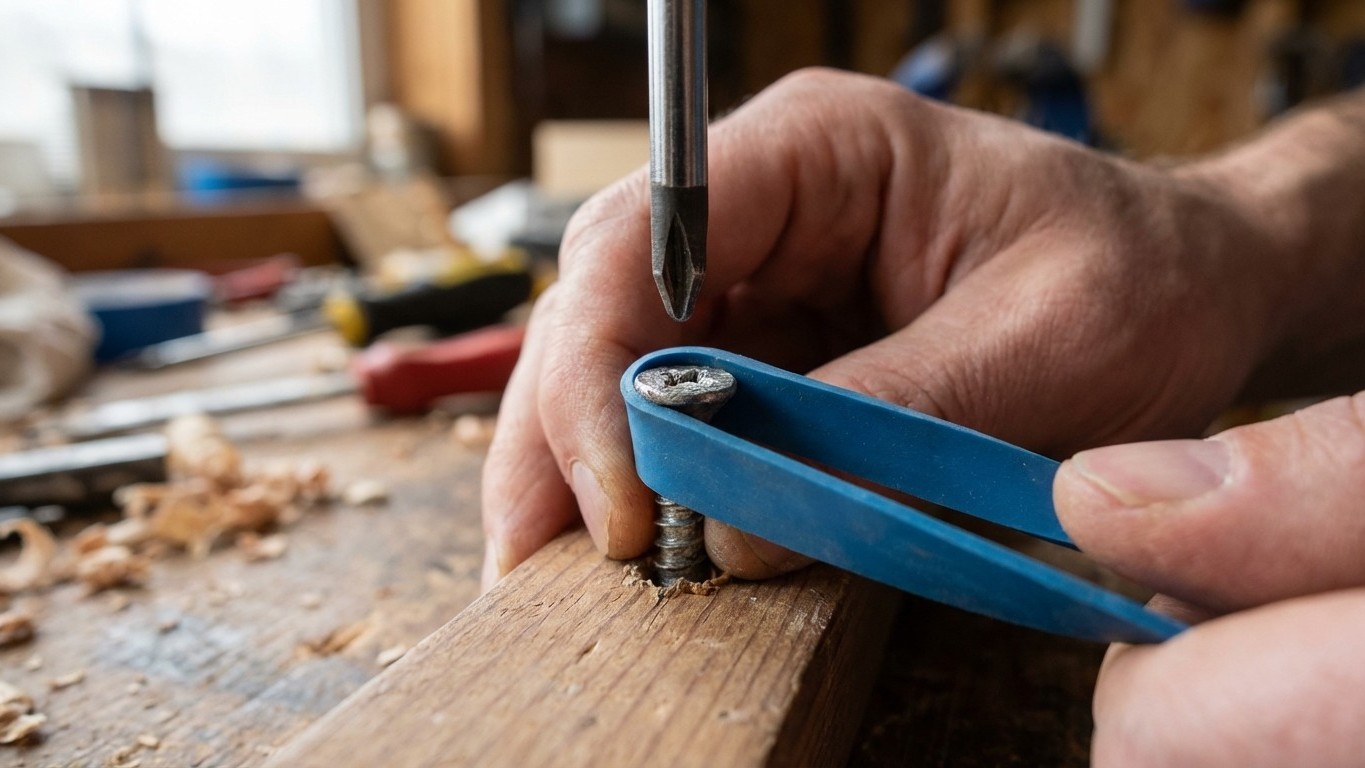
The rubber band trick works by partly filling the void of the stripped screw. The screwdriver head forces the rubber to try to fill the voids in the screw while also serving as additional friction or grip when applying firm, perpendicular downward pressure. This creates the missing connection between your tool and the damaged fastener.
The technique itself is remarkably straightforward. Removing a stripped screw with a rubber band takes less than a minute. Simply place a wide rubber band flat over the screw head, press the screwdriver firmly onto the rubber band, then turn the screwdriver slowly and steadily, allowing the rubber to grip the screw as you twist.
The elastic material provides temporary traction, converting the slipping motion into necessary rotational force to loosen the fastener. This simple rubber band offers an ingenious, low-cost solution by momentarily bridging the gap between the damaged metal and the driver tip.
Maximizing Success with Proper Technique
While the rubber band method appears simple, certain techniques can significantly improve your chances of success. The effectiveness relies heavily on selecting the appropriate rubber band, with a wide, thick option being preferable to a thin one, as it offers more material to fill the damaged void in the screw head. A thicker, broader rubber band usually works best because it provides a bigger contact area between the driver bit and the head of the screw.
Professional repair technicians recommend a specific approach for optimal results. Place a wide rubber band between the screwdriver (experts recommend bumping one size up from the screw head which caused the strip) and the screw, then apply hard but slow force as you turn. The key is maintaining steady, consistent pressure rather than quick, jerky movements.
The rubber band method is most effective when the screw head is only partially or lightly stripped, meaning the recess still retains some of its original shape. This technique functions best for smaller fasteners that require relatively low torque for removal, such as those found in electronics, cabinet hinges, or soft wood applications.
When the Rubber Band Method Falls Short
Despite its effectiveness, the rubber band trick isn’t a universal solution. This household method is generally ineffective for screws that are severely rounded, deeply corroded, or those requiring extreme force, such as fasteners in automotive or structural applications. When screws are tightly torqued or locked with thread adhesive, the limited shear resistance provided by rubber will typically fail, causing the material to tear before achieving the necessary torque.
Fortunately, alternative methods exist when rubber bands prove insufficient. Some DIY experts have found success using chewing gum in lieu of a rubber band, while duct tape serves as an equally effective alternative. Steel wool or the abrasive side of a kitchen scouring pad can be placed over the screw head to increase friction, with the rough metallic fibers filling damaged slots and offering a more aggressive texture for the screwdriver bit to engage.
Prevention: The Best Medicine
While knowing how to remove stripped screws is valuable, preventing them in the first place saves considerable time and frustration. To prevent stripped screws, you want to prevent cam-out by using the correct bit size for your screw. A lot of cam-out happens because someone uses a driver bit that’s either too big or too small for the screw’s socket. To ensure proper lock between bit and screw, use the correct size bit – if the box says the screw is a #2 screw, use a #2 screw bit.
Professional contractors emphasize several key prevention strategies. When driving a screw with a power drill, you don’t want to put the drill on its fastest speed, but you do need to apply plenty of pressure. This helps prevent the driver from skipping out of the screw’s head, thus preventing cam-out and screw stripping. Creating pilot holes can significantly help – drill a hole with a bit slightly smaller than the screw, place the screw tip in the hole and drive. Besides reducing cam-out and screw stripping, drilling pilot holes can help prevent wood from splitting.
A stripped screw doesn’t have to ruin your project. With One Simple rubber band, you can create enough grip to remove even the most stubborn screws. It’s fast, cheap, and incredibly effective. This technique represents the kind of practical problem-solving that makes DIY work both satisfying and accessible, proving that sometimes the simplest solutions are the most elegant. Whether you’re assembling furniture, repairing electronics, or tackling home improvement projects, keeping this trick in your arsenal ensures that stripped screws become minor inconveniences rather than project-ending disasters.