
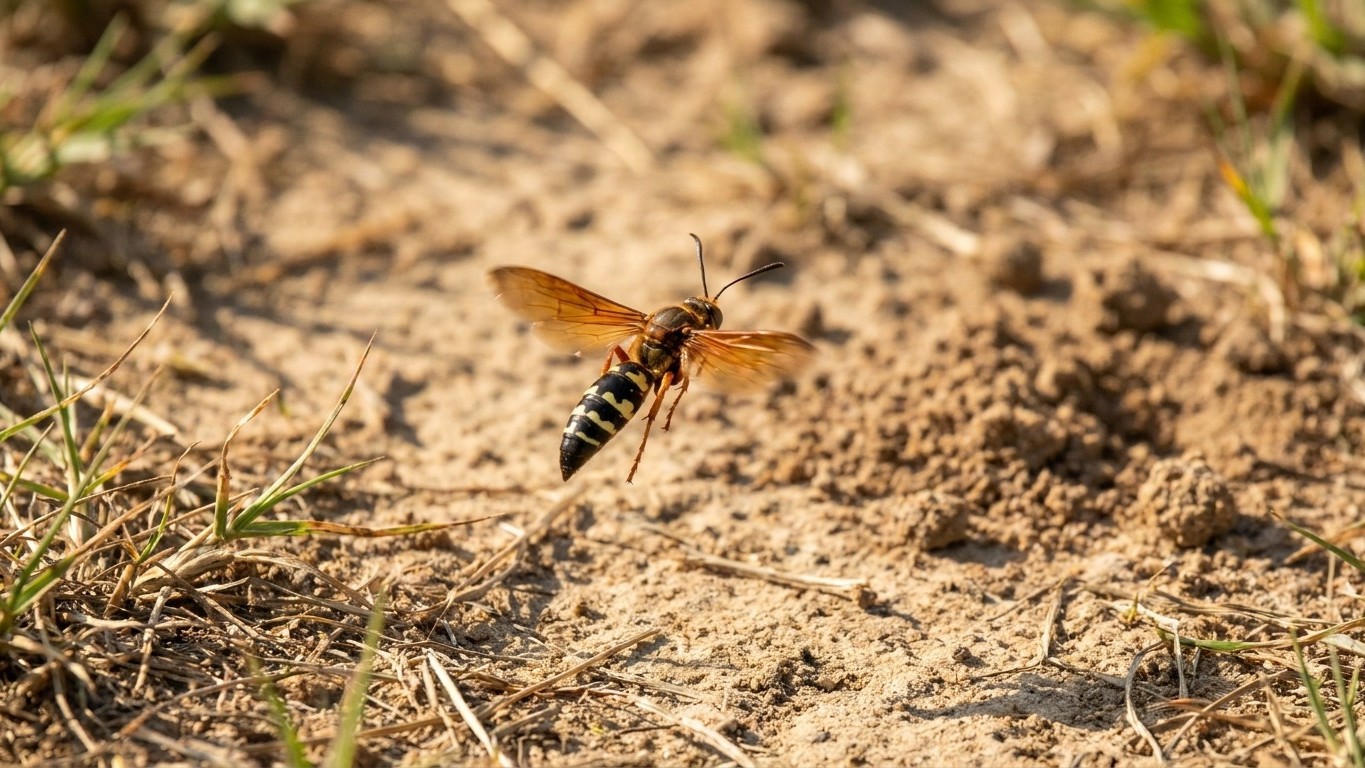
They look like something out of a nightmare: two-inch wasps with rust-colored wings, black and yellow bodies, dive-bombing across bare patches of lawn every July afternoon. Homeowners across the country are reaching for insecticide sprays, convinced they’ve found a nest of “murder hornets” in the backyard. They haven’t. What they’re seeing is almost certainly the Eastern cicada killer wasp (Sphecius speciosus), a solitary insect that’s far more helpful than harmful, and spraying it does more damage to your garden than the wasp ever could.
Key takeaways
- Giant wasps hovering over lawns are almost certainly harmless cicada killers, not invasive murder hornets
- Male cicada killers can’t even sting—females only paralyze cicadas to feed their larvae, naturally controlling pest populations
- Spraying kills native bees, beetles, and beneficial predators while poisoning your soil for months with minimal runoff effectiveness
The insect everyone mistakes for a killer
Cicada killers are native to most of the eastern and central United States, and their size alone triggers panic. Females can reach two inches long, dwarfing the yellowjackets and paper wasps people are used to. Add the hovering, patrolling flight pattern near lawns and sidewalks, and it’s easy to see why they get lumped in with the Asian giant hornet, the invasive species nicknamed “murder hornet” that made headlines a few years back in the Pacific Northwest. But the two insects aren’t even close relatives in behavior. The Asian giant hornet is a social species that attacks honeybee colonies in coordinated groups. Cicada killers are loners. Each female digs her own burrow, hunts alone, and has zero interest in stinging humans, pets, or anyone standing nearby.
That aggressive hovering you’re watching from your porch? It’s almost always a male. Male cicada killers stake out territory near burrows and chase off rivals, other insects, and even curious dogs, but they physically cannot sting. They don’t have a stinger at all. Females do carry one, borrowed from the same evolutionary toolkit as bees and other wasps, but they reserve it almost exclusively for paralyzing cicadas, not for defending themselves against people. Entomologists at university extension programs, including researchers at Ohio State University’s College of Food, Agricultural, and Environmental Sciences, note that stings on humans are rare and typically only happen if a wasp is grabbed or stepped on barefoot.
Why your lawn actually needs them
Every burrow a female cicada killer digs comes stocked with paralyzed cicadas, sometimes two or three per chamber, which serve as living food for her larvae. One cicada is roughly the size of her own body, so dragging prey back to the nest is physically demanding work. She’ll climb a tree trunk with a stunned cicada gripped underneath her, then glide down toward the burrow, sometimes crash-landing short of the entrance and dragging the meal the rest of the way on foot. It’s an exhausting, fascinating process to watch, and it happens to be a natural check on cicada populations that would otherwise strip foliage and stress trees in late summer.
The burrows themselves rarely cause the kind of damage people assume. A single female excavates a tunnel about six inches deep, leaving a small mound of soil at the entrance, similar in scale to what an ant colony produces. Multiple females sometimes nest in the same sunny, sparse patch of turf because that soil type, dry, sandy, and thin on grass cover, is easiest to dig. The result can look like a cluster of small volcanoes dotting a bare spot in the yard, which understandably alarms anyone who just reseeded that section. But the wasps aren’t feeding on grass roots, and they aren’t chewing through your lawn’s structure the way grubs do. They’re borrowing bare soil as a nursery, nothing more.
What spraying actually destroys
Reach for a broad-spectrum insecticide and you’re not just targeting cicada killers. You’re wiping out ground-nesting native bees that share the same well-drained soil, along with the beetles, ants, and other insects that keep your lawn’s ecosystem functioning. According to the U.S. Environmental Protection Agency’s pollinator protection guidance, pesticide applications aimed at one species routinely affect non-target insects that share the same habitat, including pollinators already under pressure from habitat loss. Spray a lawn full of cicada killer burrows and you may also be poisoning the soil for months, killing beneficial predators that would otherwise handle aphids, grubs, and other actual lawn pests without any help from you.
There’s a practical cost too. Chemical treatments applied to bare, dry patches tend to run off during the next watering or rainstorm, since that’s exactly the kind of loose soil cicada killers prefer, and exactly the kind of soil that doesn’t hold pesticide in place. That runoff can reach storm drains, nearby garden beds, or a vegetable patch a few feet away. Pets that walk across treated grass pick up residue on their paws. Kids playing barefoot in July, which is peak cicada killer season, get exposed to chemicals for a threat that was never really there in the first place.
What actually works
Thickening the lawn is the most effective long-term deterrent, since cicada killers specifically seek out sparse, exposed soil to dig into. Overseeding bare patches, watering consistently through summer, and mowing at a slightly higher height all make a lawn less inviting without a single chemical application. If a nesting area is unavoidable, laying down mulch or a light layer of topsoil over the bare patch in early spring, before females start scouting for burrow sites in June and July, tends to redirect them elsewhere. For anyone who simply can’t tolerate the hovering males near a patio or play area, a physical barrier like row cover fabric staked over the nesting zone works better than any spray, and it doesn’t harm anything in the process.
Most of these wasps disappear on their own by late August, once the adult females have finished provisioning their burrows and the cicada season winds down. The mounds settle, the grass fills back in, and next July the cycle starts over with a new generation that spent the winter underground as larvae. Homeowners who leave them alone typically report the same thing: a few weeks of unsettling hovering, then nothing, and a lawn that never actually needed the chemicals in the first place.