
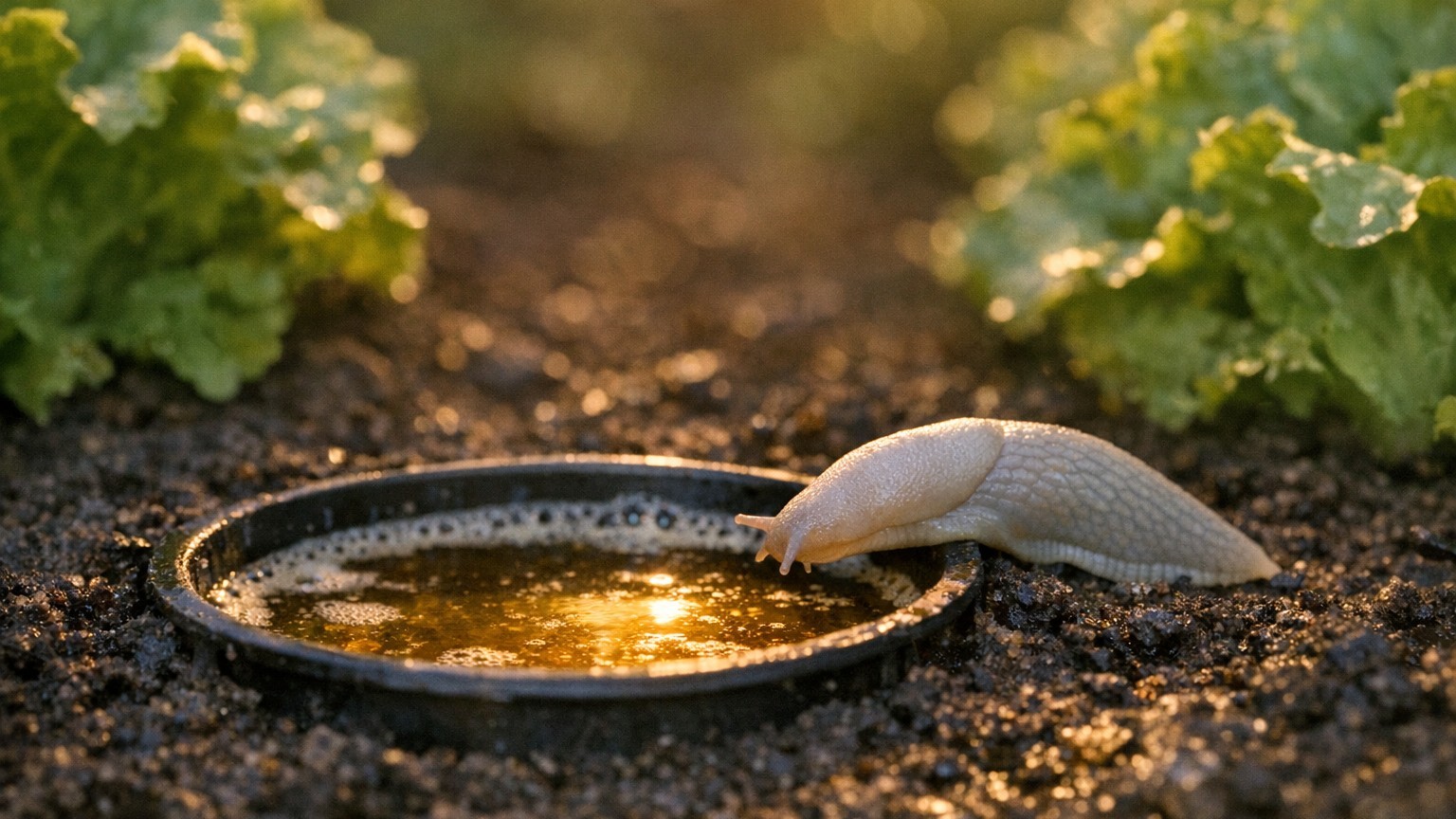
Slugs don’t announce themselves. They work at night, in the wet, and by morning all you find are the ragged edges of what used to be a head of lettuce. For years, the standard advice, sink a container into the soil, fill it with beer, count your victories in the morning — felt like progress. Until it didn’t.
The turning point came one June, crouching over a row of traps that had caught an impressive haul overnight. Dozens of slugs, floating proof that the system was working. Except the lettuce kept disappearing at the same rate. Sometimes faster. That contradiction is worth taking seriously, because it points to something most gardening guides quietly skip over.
Key takeaways
- A high body count in beer traps might mean you’re catching the wrong slugs entirely
- Most people place traps in locations that actually draw MORE slugs toward their vegetables
- The species you’re killing matters far more than the quantity—but gardeners rarely check
Beer Traps Actually Work : Just Not the Way You Think
The mechanism is simple enough. Slugs are drawn to the yeast in fermenting liquid, crawl in, and drown. Studies from the UK’s Royal Horticultural Society have confirmed that beer traps do reduce local slug populations, particularly in the immediate vicinity of the trap. The problem is the word “local.” A beer trap doesn’t protect a bed, it attracts slugs to a specific point, and whether that point is your lettuce or the trap itself depends almost entirely on placement.
Most people set traps at the edge of the bed, or worse, right in the middle of it. That’s an invitation. You’re essentially broadcasting a dinner signal across your entire garden, pulling in slugs from neighboring grass, borders, and your compost heap, then hoping they choose the trap over the plant six inches away. Research from Rothamsted Research in the UK found that slugs travel an average of four meters per night when foraging, which means a single trap can draw in visitors from a surprisingly wide radius, many of whom will detour through your lettuce on the way.
The fix is counterintuitive: place traps at least a foot away from the plants you’re protecting, and slightly uphill or upwind if your garden has any slope or prevailing breeze. You want the trap to intercept slugs before they reach the crop, not after.
The Count That Changes Everything
Counting slugs in the morning feels satisfying, but the number alone is misleading. The species you’re catching matters as much as the quantity. The UK alone has over 40 slug species, and not all of them eat lettuce with the same enthusiasm. The field slug (Deroceras reticulatum) is the most damaging to leafy vegetables, pale gray, rarely longer than five centimeters, and responsible for the majority of surface damage on tender crops. But beer traps disproportionately catch larger species like the black slug (Arion ater), which actually spends much of its time eating decaying organic matter rather than your seedlings.
That’s the trap within the trap. High body counts in your beer containers may reflect that you’re systematically removing relatively harmless slugs while the actual culprits, smaller and more agile, avoid the traps entirely or get there last. It’s a selection effect, and it explains why beds can keep deteriorating even when the nightly catch looks impressive.
A more useful diagnostic is to go out with a flashlight an hour after dark during damp weather. What you see on and around your plants at 10 p.m. is a far more accurate census than what floats in beer at 7 a.m. The small, fast ones moving across leaf surfaces are the ones to worry about.
What Actually Pushes Slug Pressure Down
Beer traps have a role, but they work best as part of a layered approach rather than a standalone solution. The most effective long-term strategy isn’t killing slugs, it’s making the garden less hospitable to them in the first place.
Soil structure is underrated here. Slugs thrive in compacted, moisture-retentive soil because it keeps them cool and damp during the day. Raised beds with well-draining compost dramatically reduce daytime hiding spots. A study published in the journal Annals of Applied Biology found that populations of Deroceras reticulatum were significantly lower in well-aerated soils compared to dense clay conditions, not because slugs migrated away, but because egg survival rates dropped sharply when soil dried out between rainfalls.
Copper tape has a mixed reputation, but the evidence supports it in specific contexts: as a barrier around containers or raised bed edges, not as a broadcast deterrent. The electrical charge slugs experience crossing copper is real, just not strong enough to stop a determined slug crossing a wide band of soil.
Timing your sowings also matters more than most gardeners acknowledge. Lettuce planted in early May, when slug pressure is still building, consistently outperforms transplants put out in late June, when populations peak. Older plants with more established leaves simply cope better with minor damage. Starting seeds indoors and transplanting at the four-leaf stage rather than as tender seedlings cuts losses dramatically without any trapping at all.
One genuinely underused method: encouraging ground beetles. Pterostichus melanarius, a common black beetle found in most temperate gardens, is a voracious predator of slug eggs and small slugs. It thrives under log piles, flat stones, and dense perennial ground cover. Every time you clear the garden to a bare, tidy finish in autumn, you’re dismantling exactly the habitat that keeps these predators around through winter. Leaving a rough edge somewhere isn’t laziness, it’s biological pest control that costs nothing and runs itself.
Beer traps, used correctly and interpreted honestly, are a diagnostic tool as much as a control method. The morning count isn’t a score. It’s data. And data only helps if you’re asking the right question, which, it turns out, is never just “how many?” but always “which ones, and where are they coming from?”