
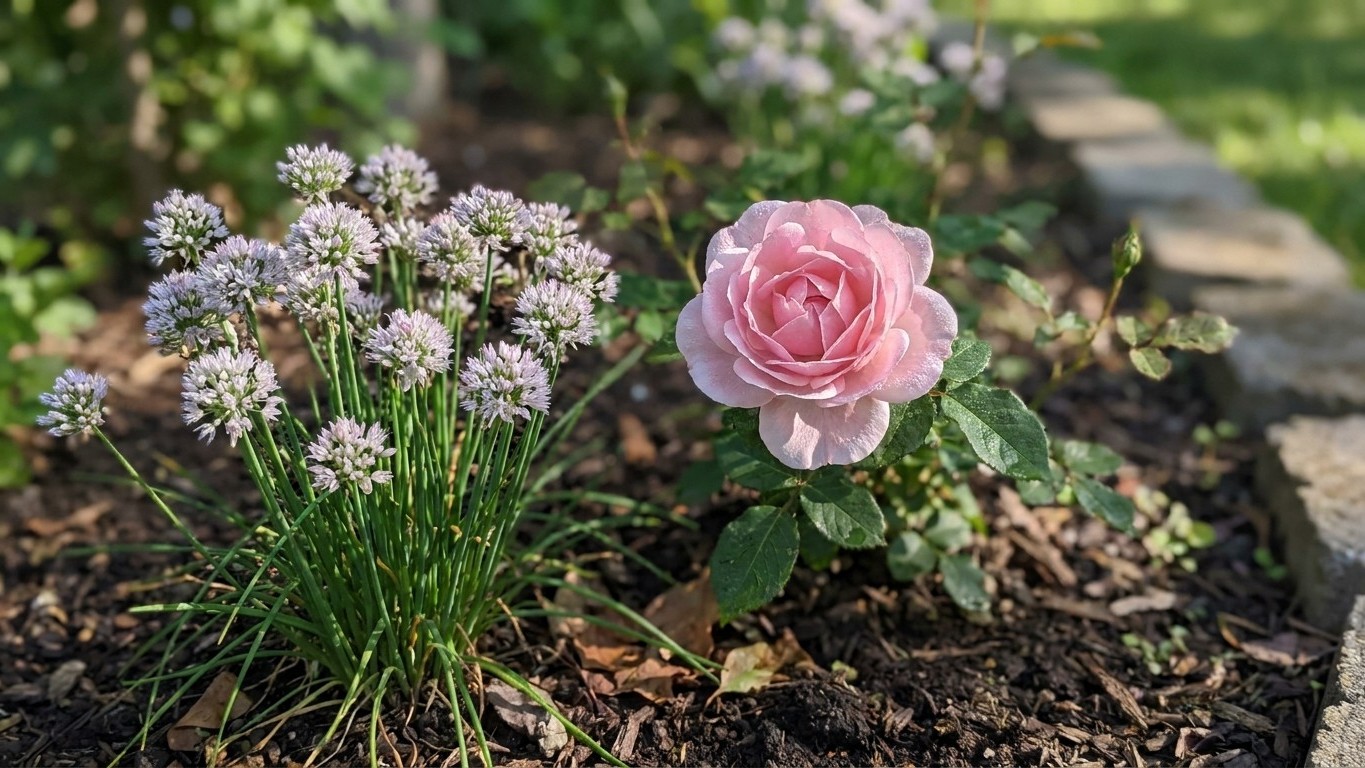
Somewhere between the vegetable patch and the rose bed, old-time gardeners drew a line that modern gardeners have largely erased. A row of chives or garlic growing beside the roses was standard practice in the classic potager, that elegant French-inspired kitchen garden where edible and ornamental plants mingled as a matter of course. Today, most of us go straight for the spray bottle at the first sign of aphids or black spot. Those gardeners never did. They grew alliums instead, and the science is starting to prove they were right.
Key takeaways
- What if the solution to your rose problems has been growing in kitchen gardens for centuries?
- Why do roses planted alongside chives and garlic stay healthier without any chemicals?
- The old gardeners waited three years for results—but modern science just proved they were onto something revolutionary
The Potager’s Forgotten Logic
The French word “potager” literally means soup, and these gardens were designed to include any seasonal ingredient that could be thrown into a pot. But they were never just rows of Vegetables. What they meant throughout history was more of a functional and beautiful kitchen garden, laid out in geometric shapes with edible herbs, flowers, fruits, and vegetables mixed in with ornamentals. Beauty and utility were inseparable. The idea that you would grow your roses in one bed, your herbs in another, and your vegetables somewhere else entirely would have struck a 19th-century kitchen gardener as deeply inefficient, maybe a little naive.
Alliums, the sprawling plant family that includes garlic, onions, leeks, chives, and ornamental globe alliums — were regular fixtures along rose borders precisely because they pulled double duty. Rose lovers have planted these in their rose beds for many years. Garlic has been known to repel many pests that bother rose bushes. Garlic chives have interesting foliage, repel some pests, and their pretty clusters of white or purple flowers look wonderful with the rose bush’s foliage. Chives and onions have been said to make roses more fragrant when planted nearby. That last point is almost too good to be true, yet it is consistently noted across horticultural sources.
What’s Actually Happening at the Root Level
Allium species, garlic, onion, chives, produce sulfur-based volatile organic compounds that aphids find genuinely repulsive. This is not folklore. Volatile masking is the most well-documented mechanism. Plants like chives and rosemary release volatile organic compounds that physically adhere to neighboring plant leaves, changing their scent profile. Aphids locate host plants primarily by smell, so when a rose smells like chives, winged aphids fly past without landing.
The numbers behind this are more striking than most gardeners realize. One intercropping study found companion-planted allium plots had roughly 80% lower aphid density compared to monoculture controls. That is not a marginal improvement. That is the difference between a healthy plant and a disaster. The defensive properties of Allium plants have long been used in eco-friendly agriculture such as intercropping to inhibit microbial pathogens or repel herbivorous predators, and it has been proven that intercropping with Allium plants decreases pests and diseases in a wide range of crops by reducing insect populations and controlling pathogens.
For black spot specifically, that dreaded fungal disease that turns a rose’s foliage into a polka-dot disaster every humid summer — alliums offer a second line of defense. Members of the Allium family are reported to increase the perfume of roses and help prevent black spot in addition to warding off insect pests. Garlic repels aphids and thrips and helps to fight black spot and mildew. The antifungal action comes from the same sulfur chemistry. Allicin has been demonstrated to be the most biologically active compound in garlic, known for its strong antimicrobial activity. In the soil and on leaf surfaces nearby, those compounds create a hostile environment for fungal spores.
Patience Is the Price of Admission
Here is where the old gardeners had something we have largely lost: time. Results are not immediate. Planted among roses, chives can help prevent black spot, but you will need patience, as it takes about three years for plantings of chives to prevent the disease. Three years. In an era where we expect results from a spray bottle within 48 hours, the idea of waiting three growing seasons for a companion plant to reach its protective potential feels almost absurd. But then again, the gardeners who planted those original potager borders were not planning for next weekend. They were planting for decades.
For volatile-masking plants like chives, positioning within 12 inches of the crop you want to protect matters. Research on chive volatiles showed that the scent compounds physically adhere to neighboring plant foliage, but only when plants are close enough for leaf-to-leaf proximity. This is the one non-negotiable: proximity. A garlic clove planted 20 feet from your roses provides zero aphid protection, volatile compounds dissipate exponentially with distance. The old-timers got this right instinctively. The row grew right at the base of the bushes, not across the path.
Which Alliums to Plant, and How to Use Them
Alliums deserve a place in rose borders. Reliable, they come back year after year, are easy to grow and undemanding, and many outstanding varieties harmonize perfectly with early-blooming roses. Chives are easy to grow and look very charming among shrub roses. For kitchen gardeners, common chives (Allium schoenoprasum) are the easiest entry point: perennial, frost-hardy down to USDA zone 3, and harvestable almost year-round in most parts of the country. But there is a second option worth growing alongside them.
Garlic chives (Allium tuberosum) are leafy, grass-like herbs with a mild garlic flavor, often used in stir-fries or garnishes. In the garden, they play a role that is both decorative and functional. Unlike garlic bulbs, garlic chives don’t grow underground cloves, instead, they spread through clumps and produce clusters of white flowers in summer that attract pollinators. One small practical note: the faded blossoms should be removed before the seed ripens, as the plant is a prolific self-sower to the point of being considered aggressive or invasive by some. Deadhead faithfully, and garlic chives become an asset. Ignore the spent flowers, and you’ll be pulling seedlings from your gravel path for the next five years.
For those wanting to lean ornamental, the larger globe alliums, drumstick alliums, giant alliums, produce the same sulfur-rich volatiles as their edible cousins and can be planted in perennial borders near roses for season-long protection that doubles as architectural garden interest. A bonus that any spray bottle could never provide.
Garlic and other members of the onion group actually increase the perfumed fragrance of the roses in your garden, a detail that feels almost poetic when you consider that the modern gardener’s first instinct is to reach for something that smells like a chemical plant. The potager tradition understood, without any research papers to cite, that the best way to protect a beautiful thing is often to surround it with something that works quietly, invisibly, season after season. That is still true. The row of alliums is still waiting to be rediscovered, right at the edge of the rose bed, exactly where it always was.
Sources : backyardboss.net | bloomingexpert.com