
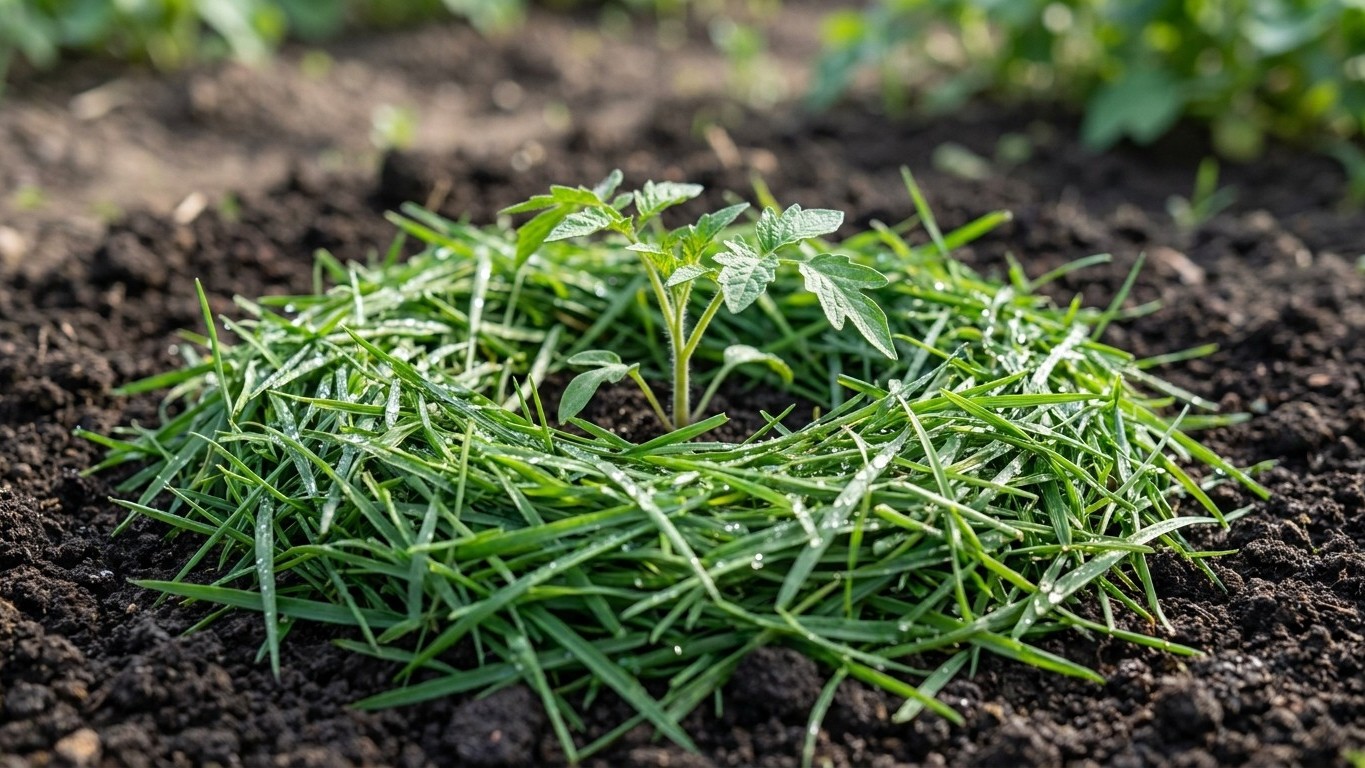
Fresh grass clippings can hit 140°F (60°C) within 24 hours of being piled together. That’s not a gardening metaphor, it’s basic microbiology, and it’s cooking your seedlings from the root up while you stand back admiring how tidy the bed looks.
Every spring, the same scene plays out in backyard gardens across the country: someone mows the lawn, scoops up a generous armful of clippings, and lays them snugly around the base of newly transplanted tomatoes or tender herb starts. The logic is sound on paper. Mulch suppresses weeds, retains moisture, and eventually breaks down into nutrients. Grass clippings are free, abundant, and feel satisfyingly circular as a resource. The problem is that fresh clippings are not mulch. They’re a composting pile waiting to happen, and the heat they generate in those first 48 to 72 hours is the same energy that kills weed seeds inside a properly managed compost bin.
Key takeaways
- Fresh grass clippings hit oven-like temperatures that kill plant cells—but only certain gardeners know this happens
- The damage is invisible for days, disguising itself as wilting or fungal disease when it’s actually thermal injury
- There’s one simple trick that makes grass clippings safe, but it requires a patience most gardeners don’t have
The chemistry happening an inch from your seedlings’ stems
Grass clippings are roughly 80% water by weight and loaded with nitrogen, typically a carbon-to-nitrogen ratio around 10:1, compared to finished mulch or straw which runs closer to 80:1. That nitrogen density is exactly what makes them attractive to soil microbes. When you pile fresh clippings several inches deep, you create anaerobic conditions: the outer layer mats together, blocks airflow, and the interior begins fermenting rather than aerobically decomposing. The result is a dense, wet, hot mass sitting directly against tissue that is, at the seedling stage, still essentially soft and undifferentiated.
The temperature spike is not gradual. Studies on green grass decomposition show the thermophilic phase (the hot phase, the one that sterilizes compost) can kick in within a day. At 130 to 140°F, cell membranes in plant stems collapse. The seedling might look fine for another three or four days before the damage becomes visible, wilting that doesn’t respond to watering, stem discoloration at soil level, or what gardeners call “damping off,” a collapse at the base that looks like a fungal problem but is often thermal in origin.
There’s also the question of what those rotting clippings release as they break down anaerobically. Organic acids, acetic acid, butyric acid, accumulate in the mat and can lower the pH immediately around the root zone, creating a micro-environment that’s hostile to roots even after temperatures normalize. A seedling that survives the heat event may still struggle for weeks without any obvious explanation.
Why the ring formation makes things worse
The classic “ring around the stem” approach concentrates the problem. Instead of a thin, dispersed layer, gardeners tend to pile clippings in a generous donut shape because it looks intentional and professional. Three to four inches of fresh clippings in a ring creates the maximum conditions for thermal damage: deep enough to go anaerobic, dense enough to trap heat, and positioned so that the hottest zone (the center of any decomposing mass) sits closest to the stem.
The ground directly beneath a thick mat of fresh clippings also warms faster than open soil during the day and holds that warmth overnight. This effect is amplified in dark-colored clippings, the green fades quickly as chlorophyll breaks down, and the mat shifts toward a darker, more heat-absorbing surface. A seedling planted in a raised bed or a container, where the root zone has less thermal mass to buffer against temperature swings, faces even more risk.
Established plants, tomatoes over a foot tall, mature perennials, woody shrubs, handle this reasonably well. Their stems are lignified, their root systems are extensive and deep, and a temporary hot zone near the surface doesn’t threaten the whole plant. Seedlings are a different category entirely. A four-inch tomato transplant has maybe an inch of stem between the soil line and its first true leaves. That inch is the whole plant.
How to actually use grass clippings as mulch
The fix is not complicated, but it requires patience, which is the gardening skill most of us are worst at. Fresh clippings need to dry before they go near seedlings. Spread them in a thin layer on a tarp or concrete surface for one to three days, until they’ve lost most of their moisture content and turned a lighter, papery texture. Dried clippings don’t mat, don’t heat, and break down at a rate the soil ecosystem handles gracefully.
Alternatively, run them through the mower a second time to shred them finer. Shorter pieces have more surface area, dry faster, and decompose aerobically rather than fermenting into a solid mass. Applied at one inch deep (maximum), dried and shredded clippings actually perform well as a mulch, they suppress weeds without smothering, and their nitrogen content becomes available to roots over several weeks rather than burning them all at once.
Keep any mulch, grass-based or otherwise, at least two inches away from the stem of every seedling or transplant. That gap seems almost ceremonial in its smallness, but it’s the difference between the protective function of mulch and the destructive one. The “volcano mulching” style, piled against the trunk or stem, kills millions of landscape plants annually, and the same principle applies at the seedling scale.
One more consideration that rarely comes up in gardening guides: clippings from lawns treated with broadleaf herbicides (products containing clopyralid or aminopyralid, common in “weed and feed” formulations) can persist through decomposition and harm garden plants even after the clippings appear fully broken down. The herbicide residue survives composting and can stunt or distort tomatoes, beans, and other broadleaf vegetables for an entire growing season. Clippings from treated lawns should go to curbside yard waste collection, not your vegetable beds.