
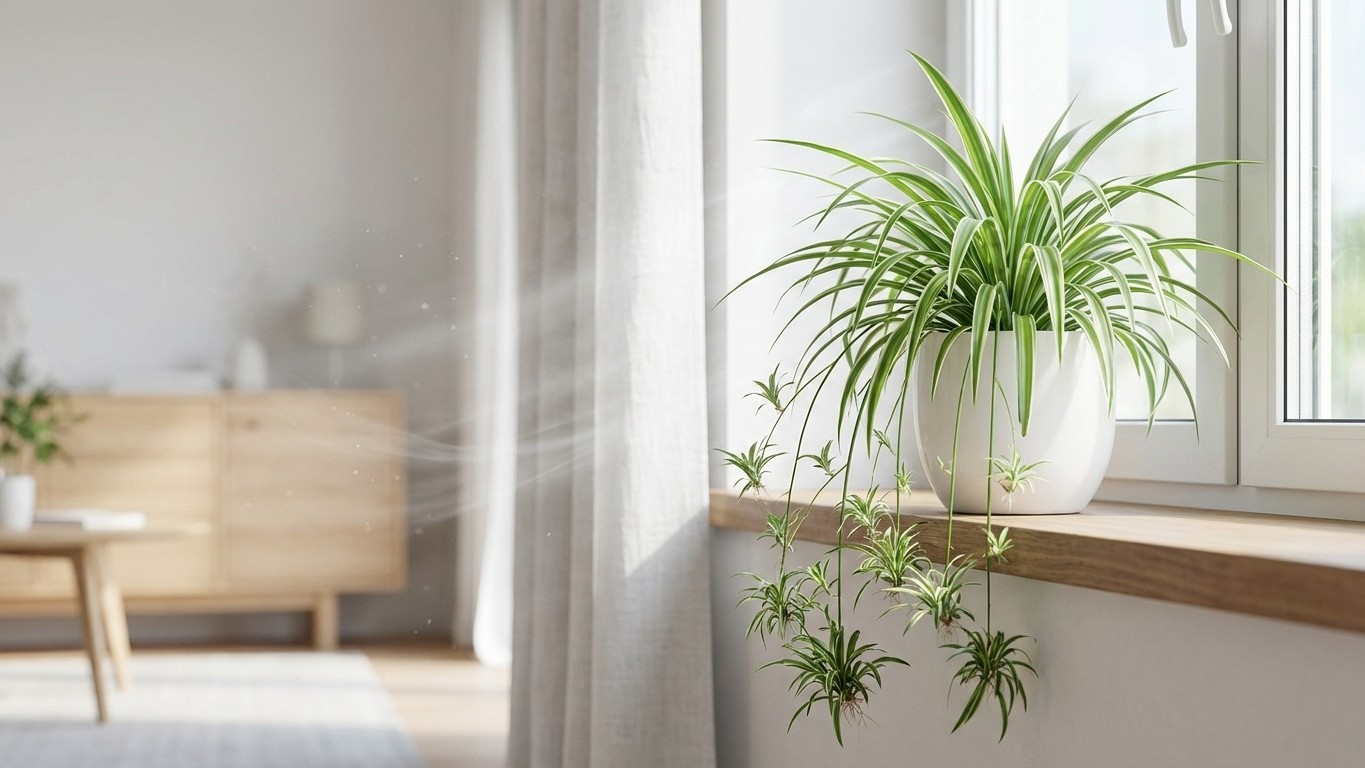
When NASA scientists searched for the ultimate indoor air purifier in the 1980s, they didn’t expect a humble houseplant to steal the show. Yet their groundbreaking research revealed that one particular species could eliminate an astonishing 95% of formaldehyde from sealed environments within just 24 hours. That champion? The spider plant—a common, unassuming houseplant that most people overlook in favor of trendier options.
The discovery emerged from NASA’s Clean Air Study, conducted in association with the Associated Landscape Contractors of America in 1989, to research ways to clean the air in sealed environments such as space stations. What scientists found challenged Everything we thought we knew about air purification. The National Aeronautic and Space Administration found in preliminary tests that spider plants were the champs, removing 95 percent of the toxic substance from a sealed Plexiglas chamber in 24 hours.
The Science Behind Nature’s Air Filter
The spider plant’s remarkable air-purifying power stems from a sophisticated biological process that works around the clock. Through their leaves’ stomata, these plants absorb airborne toxins like formaldehyde, benzene, and carbon monoxide, breaking them down through metabolic processes. The microorganisms living around the roots help Transform these harmful compounds into harmless substances the plant can use for growth. During photosynthesis, the plant converts these processed toxins into plant tissue, fundamentally turning air pollutants into new leaves and roots.
What makes spider plants particularly effective is their dual-action approach. While the leaves capture gaseous pollutants, the roots and soil play the most important role in air filtering, with plant roots and associated microorganisms in the soil doing the bulk of the work, not plant leaves. This discovery surprised even NASA researchers, who initially assumed the leaves would be the primary air cleaners.
Spider plants excel at removing multiple dangerous compounds commonly found in modern homes. With lots of rich foliage and tiny white flowers, the spider plant battles benzene, formaldehyde, carbon monoxide and xylene, a solvent used in the leather, rubber and printing industries. These chemicals infiltrate our homes through countless sources: cigarette smoke, new carpets, paints, plastics, rubbers, dyes, household cleaners, insulation, plywood, paper products, inks, adhesives, and more.
Real-World Performance vs. Laboratory Perfection
While the NASA study‘s results were impressive, real-world application tells a more nuanced story. These results are not applicable to typical buildings, where outdoor-to-indoor air exchange already removes volatile organic compounds at a rate that could only be matched by the placement of 10–1000 plants per square meter of a building’s floor space. The controlled laboratory conditions that allowed for 95% toxin removal don’t mirror typical home environments where air circulation and continuous pollutant emissions present ongoing challenges.
When considering plants for clean air in a typical home, a single spider plant can only remove about 1% of air pollution per cubic foot each hour, meaning you’ll need considerably more plants to achieve meaningful indoor air quality improvements. However, this doesn’t diminish their value—it simply sets realistic expectations. To meet the air purification needs of an average home, 8-15 spider plants would be needed to purify the air continuously.
Recent studies continue to validate spider plants’ air-Cleaning abilities while providing practical guidance. A 2022 study in the Journal of Environmental Science showed that just three spider plants can purify a 200-square-foot room, removing common pollutants like benzene and formaldehyde. This makes them far more practical than initial calculations suggested, especially when combined with proper ventilation and other air quality measures.
Beyond Air Purification: The Hidden Benefits
Spider plants offer advantages that extend well beyond air cleaning. As an added bonus, this plant is also considered a safe houseplant if you have pets in the house, making it an ideal choice for families with curious cats or dogs. Unlike many Air-Purifying Plants That can be toxic when ingested, spider plants pose no danger to household pets.
Their care requirements make them perfect for both novice and Experienced plant parents. They are non-toxic and relatively simple-rule”>simple to care for, thriving in bright light and requiring minimal watering—typically just once or twice a month. This low-maintenance nature means they can continue their air-purifying work even if you occasionally forget to water them.
The psychological benefits shouldn’t be overlooked either. Our mental health is affected in a significantly positive way, especially during the cold, dark days of winter. They reduce stress (unless you’re the type to freak out if a plant dies). The Simple presence of greenery in indoor spaces has been shown to improve mood, reduce anxiety, and enhance overall well-being.
For maximum effectiveness, spider plants work effectively alongside other air-purifying solutions, creating a thorough approach to indoor air quality management. You’ll get the best results by pairing them with HEPA air filters, which capture particles your plants can’t process, and activated carbon filters that absorb additional VOCs. This integrated approach acknowledges that while spider plants are remarkably effective biological air filters, they work best as part of a comprehensive indoor air quality strategy.
The spider plant may not be the most exotic or Instagram-worthy houseplant, but its proven ability to dramatically reduce indoor air toxins makes it an invaluable addition to any home. In a world where we spend at least one plant per 100 square feet can effectively clean the air, having these natural air purifiers working silently in our living spaces isn’t just beneficial—it’s essential for our health and well-being.